If you read nothing else I write this year, read this.
A Manifesto
A manifesto is a public declaration of intentions, motives, or views, designed to outline a vision for change, action, or core beliefs. You must be able to say, with conviction, “this is what I believe”, so here goes:
This is what I believe:
- I believe we should never build another dashboard or pull another report. Ever again.
- I believe people analytics has been treated like a luxury item, when in reality it has been a commodity for quite some time.
- I believe people analytics has always looked in the rearview mirror. People intelligence looks at the road ahead and drives business value through better decisions, sharper intelligence gathering, and faster action.
- I believe all intelligence in HR is collapsing into a single function called people intelligence, and the overall HR operating model consolidating.
- I believe people intelligence is flattening the Tree of Value into an “intelligence layer” and a “data layer”. That’s all there is. These layers, in conjunction with human effort, will drive value.
- I believe if all you know how to do is “count things” your work is already completely automatable.
- I believe there will be winners in this space. People intelligence work is exciting. There is a bright future for those who are early to change and adapt.
- I believe you will never see another hundred person analytics team again. A people intelligence team will be nimble, technology-forward, AI-native, and cost effective.
- I believe the ability to pay for a people intelligence team ten times over is too low a threshold, and it should easily become 100x if done correctly.
- I believe none of this is controversial, and these sentiments are already largely shared by most leaders in the field. Those leaders are only worried about saying them out loud. So I will say it for them.
I’ve been crafting these thoughts for a while, leaving a trail of breadcrumbs in earlier articles. I used to have fear of being wrong and my own self-doubts on this topic. I am no longer afraid. The world has already changed. Every leader I talk to knows it. The future is here, and the future is people intelligence.
So what is people intelligence?
People intelligence is meant to bring a singular focus to providing intelligence to decision makers as close, as quickly, and as cheaply as possible for the business problems they face. Intelligence, historically, has existed in many functions throughout HR, mainly due to the fragmented HR operating model most companies deploy. That operating model has been breaking down for a while, and is now officially broken. The “intelligence” and “data” layers needed to solve business problems should be centralized, the insights should be democratized, and the technology to make it possible should be AI-native. Today.
To be clear: This isn’t only an argument about org charts and whether your company collapses all these functions into one team (hint: they will). The collapse I’m describing is also tactical. The work itself, the methods, the technology, and the output are all converging as well.
The distinction that practitioners are starting to draw is roughly:
- People analytics = analyzing internal HR data to improve decisions
- Talent intelligence = external labor market insight about candidates and talent pools
- People intelligence = a broader frame that integrates both internal and external data, behavioral data, and “intelligence gathering” alongside AI as its core processing unit into something more like true organizational intelligence about people.
People intelligence is inclusive of all the intelligence that happens in HR. AI workforce transformation, yes. Employee listening, yes. Benchmarking, yes. Even the data for core dashboards and reports. People intelligence can be defined as concentrating the methods of “intelligence gathering” in organizations and applying those precepts to the workplace and its employees.
Why now?
We have a new set of business problems to tackle. We are all facing AI workforce transformation. The world of work is changing beneath our feet. You need data about workforce planning, skills, tasks, and how humans + AI can work. You also need to undergo this transformation while controlling your costs, because cost pressures are as high as they’ve ever been. And, you need to be able to prove your function is utilizing AI for business value – while not dropping the ball on all your existing people analytics and data management obligations. Sounds easy, right?
This is why I joined HRBench as the world’s first Chief People Intelligence Officer. We are boldly committed to building and scaling people intelligence. We are looking for fellow travelers for our journey. We currently have the scaffolding of AI-native capabilities, the data layer for breaking down all your silos, and building the collapse of people analytics, workforce planning, talent intelligence, and behavioral science into one single function as we speak. Want to go on the journey with us? Want to influence the future? Want to make a name for yourself along the way? Reach out to me to learn more.
Goodbye Tree of Value
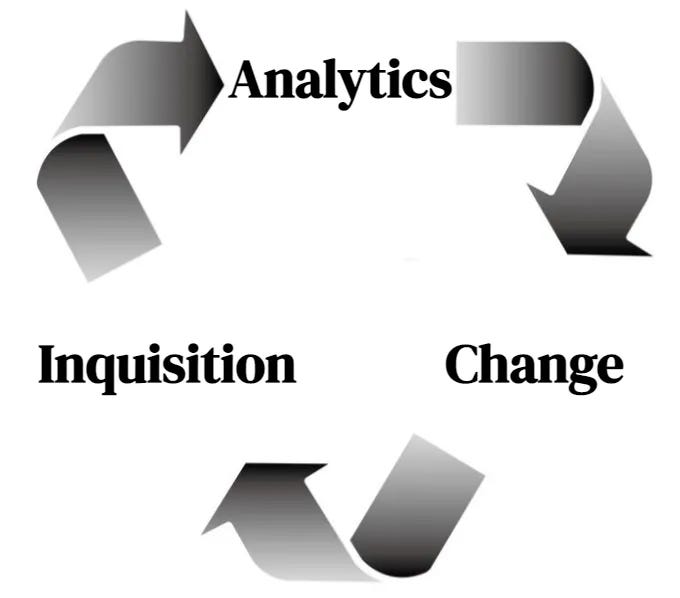
The Tree of Value (seen above) is one of the most popular things I’ve ever written about – less than a year ago. The Tree is also officially flattened. Funny how much can change in a year. People analytics, workforce planning, talent intelligence, and behavioral science are all collapsing into one singular function. A function in which AI is embedded into everything. All that’s left from the “Tree” is the intelligence and the data. That’s it. The value comes from the collapse into people intelligence. This allows for making decisions, taking action, and quantifying the impact in a singular, cheap, and AI-native way. Sometimes I’m early to these prescriptions. I’m not early this time. I introduced The Inquisitor and The Change Agent as a potential model of the future of people analytics back in 2023. The argument was simple: As AI matures, the ability to run an analysis in people analytics stops being the bottleneck. All analysis gets commoditized and automated. The bottleneck shifts to asking the right questions (The Inquisitor) and driving action on the answers (The Change Agent).
So what happens to people analytics? My old colleague Luka Babic recently wrote a swan song to people analytics, and Yuyan Sun and Colby Nesbitt recently wrote about the field’s midlife crisis. Conversely, Alexis Fink recently quipped that People Analytics is Not Dead. No, it’s not dead – but people analytics has become a commodity. It should be clear from my recent post showing how Claude in Excel is Insane and how I built an entire dashboard in Excel with a single prompt and about one minute of processing, that something radical has happened. In that article I said: “The value of “analysis” in people analytics is collapsing before our eyes.”
Similarly, Zach Williams and I wrote recently that:
“AI has changed what’s measurable, shifted where the bottlenecks live, and amplified the cost of mistakes. The “intelligence” layer on which people analytics teams have built their value proposition is collapsing before our eyes…..AI can commoditize the analysis. [But] it can’t commoditize the judgment, the organizational trust, or the human expertise required to combine those disciplines in ways that hold up under scrutiny.”
There is still a bright future for people who are early adopters of people intelligence; who ask the right questions and take the right actions. Be one of them.
What does “intelligence” mean?
If people analytics is collapsing, people intelligence is the successor ideology to people analytics. People analytics was always difficult to define because as Amit Mohindra found in his dissertation research, there were over a hundred different definitions and none of which are agreed upon as the canonical one. I always hated defining people analytics because it was so amorphous. People intelligence is not amorphous. It is all the intelligence and data that HR needs to run its function.
As I spoke about with Kristin Saboe recently, we’re leaving the “business intelligence” phase of data and moving into the “Intelligence Gathering” phase following in the footsteps of others:
“The armed forces and intel agencies have long deployed intelligence gathering mechanisms to gain insight and advantage. The typical groupings for a military application include job codes, such as: human (HUMINT), signals (SIGINT), geospatial (GEOINT), imagery (IMINT), measurement/signature (MASINT), and open-source (OSINT) intelligence. Quite different from business intelligence, right?”
And we should be able to have this “intelligence” quickly, cheaply, and correctly. Recently Zach Williams and I wrote:
“Not long ago, a people analytics project meant six months of data wrangling from disparate sources, stakeholder alignment, and slide-building before a single insight reached a decision-maker. Advances in data warehousing and visualization collapsed that timeframe to six weeks, then modern dashboarding brought it down to six days, and as teams matured and machine learning entered the mix, six hours became the new benchmark. Now, with tools like Claude handling data analysis end-to-end, we can even operate in six minutes on occasion. Which raises the obvious logarithmic improvement question: how long before it’s six seconds?”
The Future is Now
People intelligence should be cheap. Like cheaper than the cost of a single analyst. Why should you have to hire more people and buy more technology to just barely get to the basics of a “shared set of facts” for HR? Implementation should be fast and easy for users. No more mega-people analytics teams needed. No more multi-hundred thousand or million dollar technology contracts. AI-native capabilities out of the box, and intelligence democratization for the masses. Simple as that.
So what does it actually look like? Instead of building a dashboard to answer a business question, you type a business question into a chat interface and get a synthesized answer, with the data, the context, and the recommended action almost instantly. The output is intelligence, not just visualization.
But won’t AI displace everything you build?
Our team has adopted the mindset of: Build the thing you’re worried about getting disrupted by.
As an example, if you’re worried that Claude Code can build some new feature quickly, why not just build the same feature quickly and cheaply while simultaneously integrating MCP servers for Claude Code to be accessible in your product. Boom, fixed. Build the thing you worry about disrupting you. Anyone can adopt this mindset.
When you adopt this mindset, that means you can ship new products and features at a speed we’ve only dreamed of. That could look like:
- AI-native data collection and management
- Employee lifecycle surveys and listening with sentiment analysis built in combined with all your other employee data
- Workforce planning for managing your people, AI agents, salary costs, and tokenomics
- Fully automated job architecture, skills, and tasks for the future or work
- Predictive and prescriptive analysis, AutoML, anomaly detection, and turnover risk
All built, or actively being built. Build the thing you’re worried about getting disrupted by.
But be warned..
Tyler Weeks and I mentioned in We Can Be Better that,
“If you take the challenge above seriously, you’re going to get some truly wild, crazy, and even ethically fraught ideas. Some of those ideas might be interesting but too risky to try in the wild on first pass. For those truly wild ideas, we need a renewed partnership between industry, academia, and government.”
We live in a transformative time in a world that is transforming before our eyes. In The Camera, I gave a fictional forewarning that we could be building a world we don’t want to live in. And as Kristin and I mentioned in Three Kinds of Intelligence, the key argument is no longer can we do these things, because we can. The key point is how should we do these things in an ethical and employee friendly manner?
This is the moment. I’m here for it. Are you?
Originally posted on the Directionally Correct Substack.