

It's 4 PM the day before the board meeting. Your CFO's deck says 1,147 employees. Your deck says 1,203. You have two hours to figure out why. You've been here before.
Both Numbers Are Right. That's the Problem.
The headcount disagreement between HR and Finance gets misdiagnosed every time. Leadership assumes someone made a data error. They launch reconciliation projects. They spend hours combing through spreadsheets to find the "wrong" number.
Both numbers are correct. HR and Finance are counting different things.
HR counts people. Every person employed by the organization, regardless of hours worked, cost center assignment, or start date. If they signed an offer letter, they're a person. If they're on leave, they're still a person. If they work 20 hours a week, they're a person.
Finance counts funded positions. Full-time equivalents assigned to cost centers with approved budget lines. A part-time employee is 0.5 FTE. An accepted offer without a start date doesn't exist yet. Someone on unpaid leave might not appear because their cost center isn't being charged.
Neither department is wrong. But nobody documented which definition each team is using, so the numbers diverge silently for months until someone puts both on a slide. Then the room spends forty-five minutes arguing about who miscounted instead of discussing the workforce plan.
When that happens, your biggest line item is the one under dispute. Labor costs consume roughly 70% of total operating costs at most companies. If HR and Finance can't agree on how many people you employ, budget forecasts drift, hiring plans stall in approval limbo, and the quarterly reconciliation becomes a ritual that burns analyst hours without producing better decisions.
The Sapient Insights Group found that only 23% of finance leaders view HR as a strategic partner. Moments like this are why. Not because HR's data is bad, but because the discrepancy makes it look bad.
In most organizations, Finance's number carries more weight. They control the budget, report directly to the CEO, and their data has institutional credibility that HR data often lacks. A shared definition document levels that dynamic. When both departments agree on the rules in advance, the question stops being "whose number is right?" and becomes "what does our agreed number say?"
Where the Number Breaks
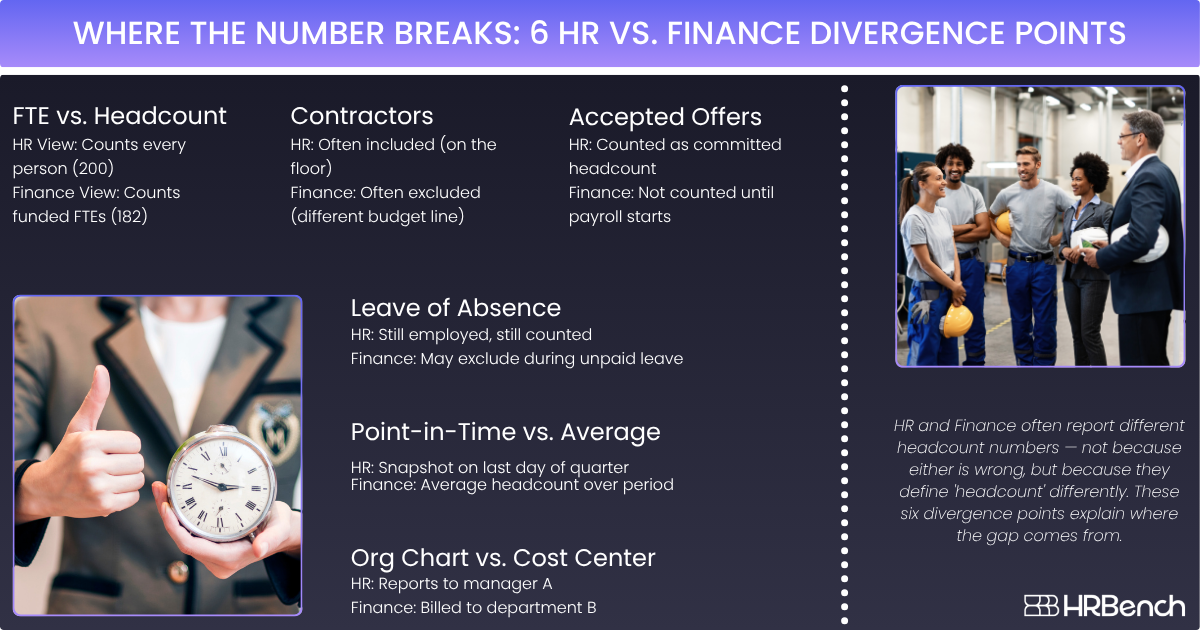
The divergence follows a predictable pattern. Once you see it, you can diagnose your specific gap in fifteen minutes.
FTE vs. headcount. The most common split and the easiest to fix. 200 employees that include 35 part-time workers equals 200 headcount but roughly 182 FTE. HR reports 200. Finance reports 182. Both are technically correct. They're answering different questions.
Contractors and contingent workers. Finance often excludes contractors because they're paid through a different budget line, not payroll. HR sometimes includes them because they're on the floor doing the work. In healthcare, this gets messy fast: travel nurses, per-diem clinicians, and agency staff show up in scheduling systems but never appear in the HRIS.
Accepted offers that haven't started. HR counts them because they represent committed headcount that needs to be reflected in planning. Finance doesn't count them because there's no payroll record yet. If you extended 15 offers in the last two weeks, this alone explains the gap.
Leave of absence. HR counts employees on leave because they're still employed. Finance may exclude them during unpaid leave because the cost center isn't being charged. This fluctuates seasonally and makes month-over-month comparisons unreliable if nobody agrees on the rule.
Org chart vs. cost center. This is the one most teams miss. Your org chart shows who reports to whom. Your cost center hierarchy shows who pays for whom. When a marketing analyst sits on the product team but is billed to the marketing budget, they appear in different places depending on which hierarchy you pull. In organizations with significant cross-billing, this affects 15-20% of headcount.
Point-in-time vs. average. HR often reports headcount as of a specific date, like the last day of the quarter. Finance may use average headcount over the period for cost calculations. A company that hired 40 people in December will show dramatically different numbers depending on which method you choose.
These six divergence points don't operate in isolation. Stack three or four of them, which is typical at companies with 1,000+ employees, and the gap between HR and Finance can reach 5-8%. At a 1,200-person organization, that's 60 to 96 people unaccounted for in someone's report. Enough to change a budget conversation entirely.
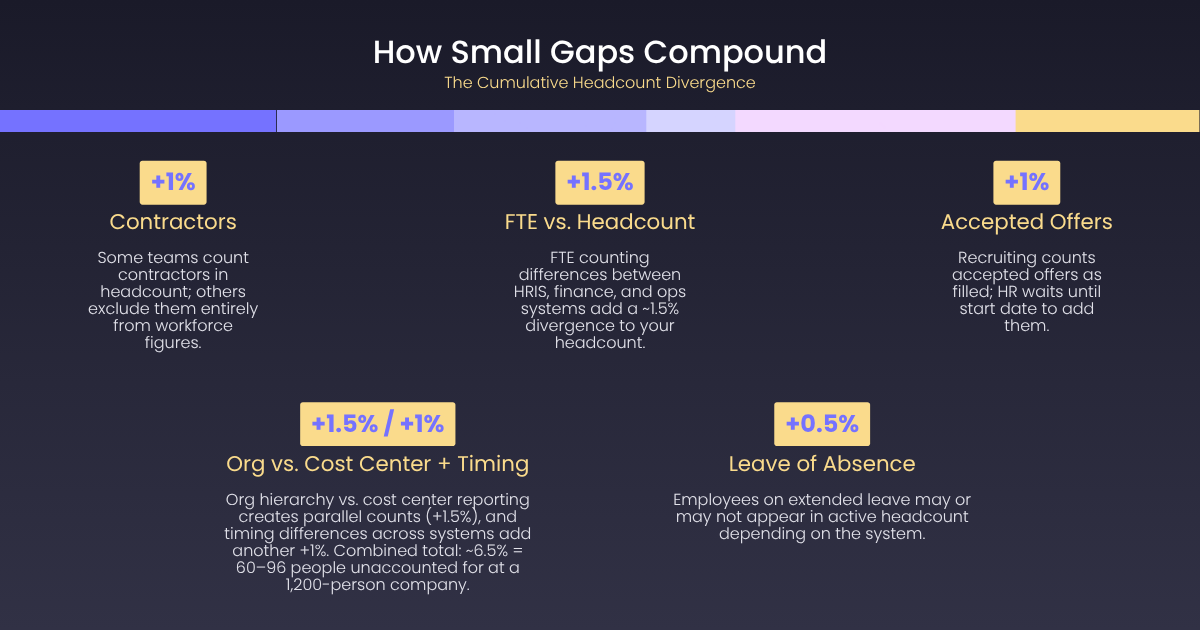
Each of these is a legitimate business decision about how to count. The problem isn't that the decisions were made differently. The problem is they were never made together.
The 30-Minute Meeting That Saves 40 Hours a Quarter
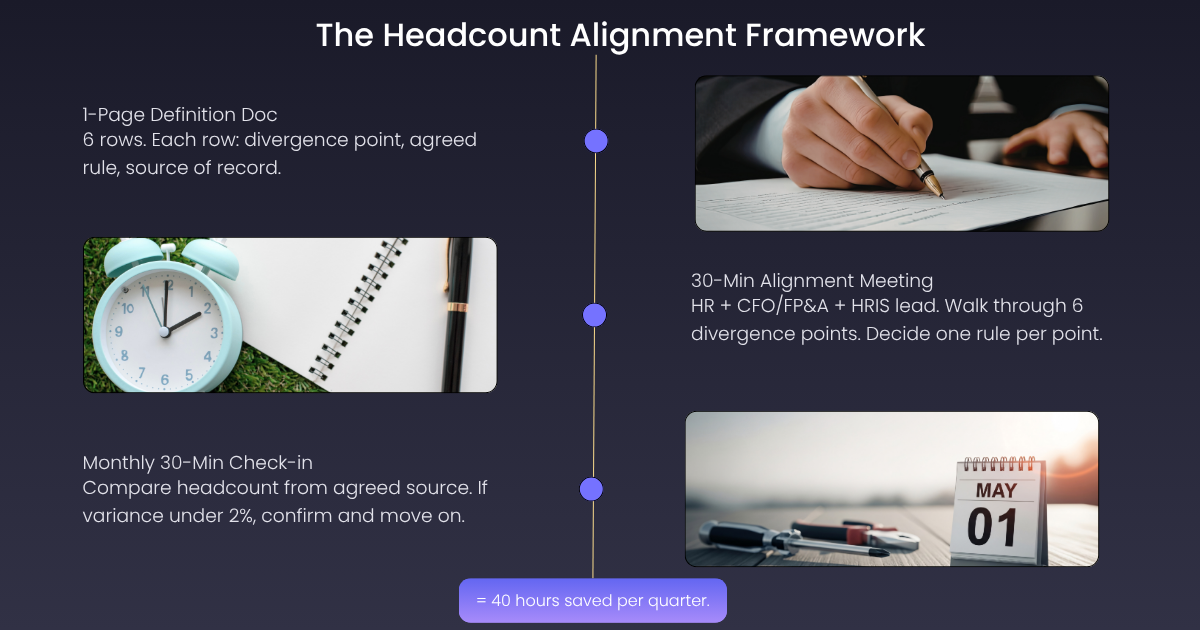
The fix is not a new system or a reconciliation project. It's a single 30-minute meeting with your CFO or FP&A lead to make six decisions.
For each divergence point above, agree on one rule. The specific rule matters less than the fact that both departments signed off on it. "For board reporting, we count headcount this way." Document it. That's your headcount definition document.
Who's in the room. VP or Director of HR, CFO or FP&A lead, HRIS lead if you have one. Three people. Not a committee.
The agenda. Walk through each divergence point. For each, ask two questions: "How does HR count this today?" and "How does Finance count this today?" Then decide which number the board deck uses. Write it down.
Some of these decisions take two minutes. Most boards want both FTE and headcount on the same slide, labeled clearly. Others require a judgment call. Contractors in healthcare might be reported as a separate line rather than included or excluded. The point is making the call together, once, instead of discovering the disagreement the night before every board meeting.
The output. A one-page document. Six rows. Each row names the divergence point, states the agreed rule, and identifies which system is the source of record. This document doesn't need to be perfect. It needs to exist.
The cadence. After the first meeting, schedule 30 minutes monthly with your FP&A counterpart. Pull headcount from the agreed source of record. Compare it to Finance's budget forecast. If the variance is under 2%, confirm and move on. If it's over 2%, trace it to the divergence points in your definition document. Nine times out of ten, the explanation maps to one of the six categories you already agreed on, and the conversation takes ten minutes instead of four hours.
Research from HiBob found that 68% of managers say missing or conflicting information contributes to worse business outcomes at least half the time. The definition document won't eliminate every conflict. But it changes the conversation from "your number is wrong" to "this variance needs investigation." That's a conversation between partners, not adversaries.
The next time your headcount doesn't match Finance's, skip the instinct to defend your count. Ask a different question: "What are we each counting?"
That question, asked once with a pen in hand and your CFO across the table, is worth more than any reconciliation spreadsheet or any Friday afternoon spent tracing discrepancies through three systems. Budget season is a few weeks out. The meeting takes thirty minutes.
